
Rules of Thumb for Surface Assessment
*A quick guide for visual inspection in everyday practice.
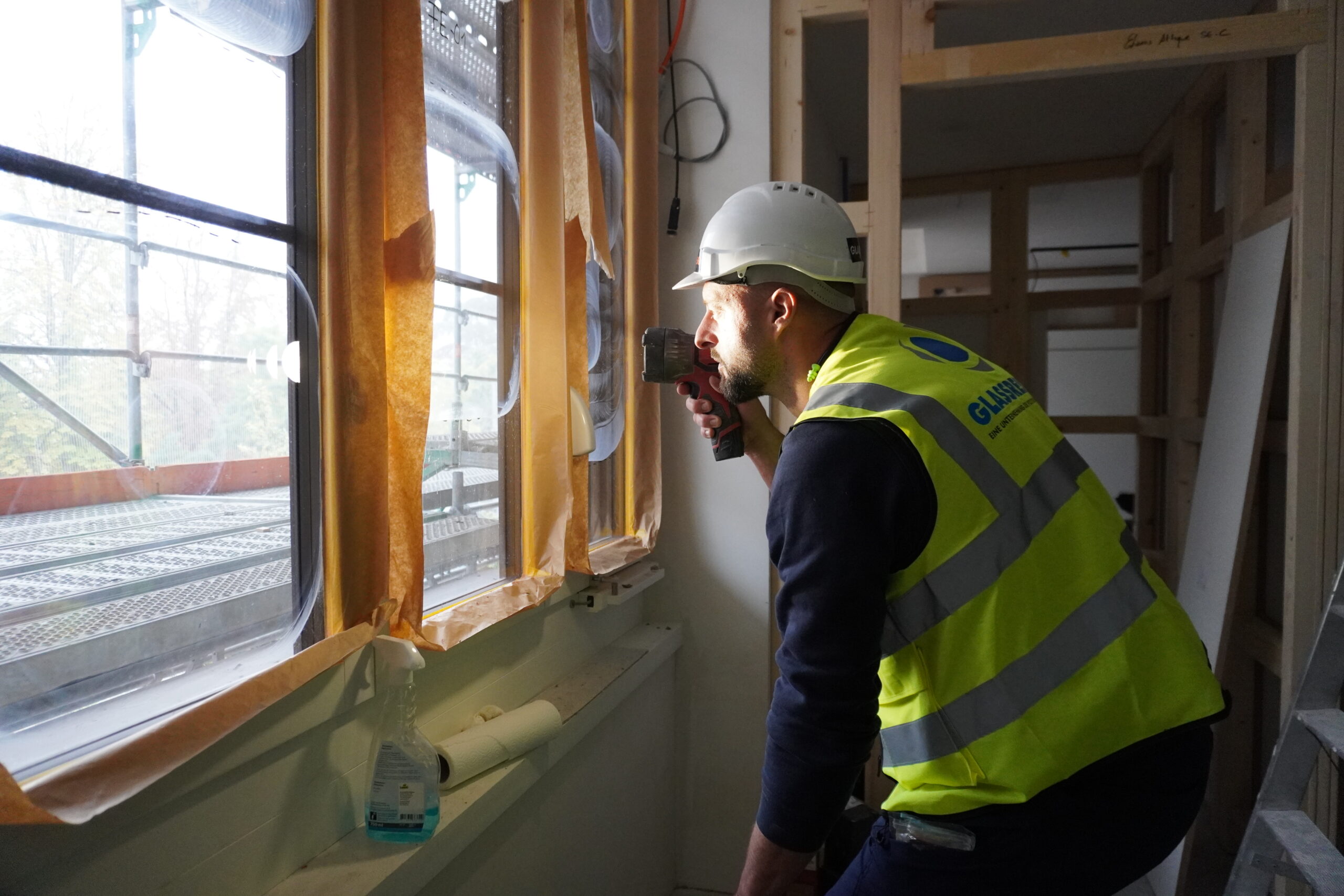
Glass surfaces – Acceptance conditions (Switzerland)
Inspection conditions (according to SIGAB / SR 006:
-
 Distance: 3 meters (distance from the glass)
-
 Lighting conditions: Diffuse daylight (e.g., overcast sky) without direct sunlight or artificial lighting
-
 Viewing angle: from the inside out and from an angle corresponding to the usual room usage
- lMarkings: Defects must not be marked during inspection.
- sOther: Interior glazing is inspected under the lighting conditions intended for normal use. The inspection of exterior glazing is carried out according to the usual viewing perspective of the building as a whole.
Only deviations visible under these conditions are considered defects. Anything that is only noticeable in raking light or with aids (e.g., flashlight, magnifying glass) is not considered a defect.
Practical examples
- Scratch in the center of the pane, clearly visible from 3 m → Defect
- Scratch visible only in raking light or with a flashlight → Not a defect
- Bubble in the middle of the pane, noticeable from 3 m and larger than 3 mm in diameter → Defect
- Small streaks at the edge, not disturbing from 3 m → Acceptable
- Slight roller waves in insulating glass (thermally induced) → Acceptable
Powder coatings –
Acceptance conditions (Switzerland)
Inspection conditions (according to SIA 118 / Qualicoat / SZFF 41.07):
-
Distance: 1–3 m (depending on the component size; smaller parts closer, façade elements farther)
-
Lighting conditions: Normal daylight or standard room lighting, no direct sunlight or raking light.
-
Viewing angle: Perpendicular or slightly inclined to the surface, at normal viewing height.
Only deviations visible under these conditions are considered defects. Features that are visible only in grazing light or from unusual angles are considered acceptable optical tolerances.
Typical inspection points during acceptance
- General surface
- Uniform color and gloss across the entire area.
- No visible inclusions, scratches, pinholes, runs, or defects under inspection conditions.
- Minor structural differences in metallic or finely textured coatings are permissible if they are not visually disturbing.
- No bubbles, chipping, or peeling.
- Color and gloss
- Color according to the agreed sample or RAL/NCS reference.
- Gloss deviations of ±5 GU (Gloss Units) are industry standard and acceptable.
- Slight color deviations may occur in recoated areas if not noticeable.
- Edges, profiles, and hard-to-reach areas
- Coating must be complete, with no defects, drips, or runs.
- No visible defects or overspray at 1–3 m distance.
- Powder coating should also have sufficient thickness on edges (corrosion protection!).
- Adhesion / Function
- Coating adheres firmly and evenly (adhesion test according to ISO 2409 or GSB/Qualicoat test).
- No blistering or corrosion under the coating.
Practical examples
- Clearly visible scratch or runs at 2 m → Defect
- Minor structural differences in metallic effect, barely visible at 2 m → Acceptable
- Uncoated edge → Defect (corrosion risk)
- Minimal dust inclusions, not noticeable at 3 m → Acceptable
- Chipping or blistering → Defect
Floors – Acceptance Conditions
Inspection conditions (according to SIA 118):
-
Distance: 1.5 meters – 1.8 meters (standing upright, normal viewing height)
-
Lighting conditions: Diffuse daylight, no direct sunlight, no grazing light
-
Viewing angle: Perpendicular to the surface
Only deviations visible under these conditions are considered relevant.
Typical inspection points:
- Surface: no visible scratches, chips, or dents; natural structures (color variations, veins, pores) are typical for the material.
- Edges & cut-outs: clean and even, without breaks.
- Installation: covering must lie flat; transitions and joints must be level and tightly sealed.
- Connections: silicone and maintenance joints must be closed (note for client maintenance responsibility).
Standards / Basis:
- SIA 118 “General Conditions”
- SIA 118/222 “Plastering Works” (transferable for flatness tolerances)
- Manufacturer specifications are binding (often stricter than the standard).
Floors (parquet, stone, tiles, etc.) – Acceptance conditions (Switzerland)
Inspection conditions (according to SIA 118):
-
Distanz: 1.5 Meter - 1.8 Meter (aufrecht stehend, normale Betrachtungshöhe)
-
Lichtverhältnisse: Diffuses Tageslicht, keine direkte Sonneneinstrahlung, kein Streiflicht
-
Betrachtungswinkel: Senkrecht zur Oberfläche
Only deviations visible under these conditions are considered relevant.
Typical inspection points:
- Surface: no visible scratches, cracks, or chips; natural color and structural differences in wood/stone are permissible.
- Flatness: according to SIA 118/253 “Floor Covering Works” and SIA 118/248 “Tiling Works”; no disturbing edges or transitions.
- Joints: uniform, closed; no open edges. Maintenance joints are service joints (note to client).
- Parquet: joint formation over the year (wood shrinkage) is normal; no glue or lacquer residues.
- Tiles/stone: no cracked tiles, edges without chips; uniform joint system.
Standards / Basis:
- SIA 118 “General Conditions”
- SIA 118/253 “Floor Covering Works”
- SIA 118/248 “Tiling Works”
- SMGV leaflets (Swiss Painters and Plasterers Association) for surface quality
Practical note (applies to all components):
- Acceptance is carried out by visual inspection according to SIA 118, Art. 157/158 → no assessment under grazing light or with a magnifying glass.
- Material-typical properties (color nuances, grain, pores, hairline cracks) are not considered defects as long as function and protection are not impaired.
- Maintenance joints (silicone, etc.) are not permanent → maintenance responsibility lies with the client.
Kitchen countertops – Acceptance conditions
Inspection conditions (according to SIA 118, Art. 157/158):
-
Distance: 1.5 meters
-
Lighting conditions: Diffuse daylight or standard room lighting, no spot lighting (no grazing light).
-
Viewing angle: Perpendicular to the surface
Only deviations visible under these conditions are considered defects.
Typical inspection points:
- Surface: No visible scratches, chips, or impact marks; natural structures (color variations, veins, pores) are typical for the material.
- Edges & cutouts: Clean and uniform, without breaks or chipping.
- Installation: Covering must lie flat; joints and seams must be even and tightly sealed.
- Connections: Silicone and maintenance joints must be closed (note: maintenance responsibility lies with the client).
Standards / Basis:
- SIA 118 “General Conditions”
- SIA 118/222 “Plastering Works” (transferable for flatness tolerances)
- Manufacturer specifications are binding (often stricter than the standard).
Praxis-Beispiele dazu
- Scratch visible under normal light from 1.5 m → Defect
- Fine scratch only visible under flashlight or grazing light → Not a defect
- Chip on edge clearly visible from 1.5 m→ Defect
- Cloudy structure or natural veining in stone, material-typical → Not a defect
Sanitary Fixtures –
Acceptance Conditions (Switzerland)
-
Distance: 0.5 – 1.0 m (usual viewing distance during use)
-
Lighting conditions: normal room lighting or diffuse daylight, no extreme or directed lighting (no grazing light).
-
Viewing angle: perpendicular to the surface, from a normal eye-level perspective.
Only deviations visible under these conditions are considered defects. Phenomena that are visible only in grazing light or from unusual angles are not relevant (SIA 118, Art. 157/158).
Typical inspection points during acceptance
- General surface
- Free from visible scratches, cracks, chipping, bubbles, or inclusions.
- Uniform gloss level, no color deviations within a single item.
- Small, barely visible production features (e.g., casting seams, minor unevenness) are permissible if they are not visually disruptive.
- Installation / Mounting
- Sanitary fixtures installed plumb and level.
- No visible gaps, leaks, or loose fastenings.
- Transitions to walls or floors sealed tightly and neatly (silicone joints = maintenance joints).
- Functional check: all drains, supply lines, and faucets tested for tightness and proper operation.
- Function / Operation
- Faucets operate smoothly, without dripping or jerking.
- Flushes, drains, and actuators function properly.
- No water accumulation or residue on horizontal surfaces.
- Accessories & Seals
- Rosettes, covers, screws, and seals fully and correctly installed.
- No visible silicone residues, adhesive remnants, or stress cracks.
Practical examples
- Scratch on sink, clearly visible from 0.5 m → Defect
- Fine casting seam, visible only in grazing light → Not a defect
- Silicone joint open or with a gap → Defect (rework required)
- Faucet drips or runs after use → Functional defect
- Minor unevenness in ceramic, not visible from 1 m → Acceptable
Interior Walls –
Acceptance Criteria (Switzerland)
Inspection conditions (according to SIA 118 / SMGV / BFS)
-
Distance: 1.5 – 2 meters
-
Lighting conditions: Normal daylight or standard artificial lighting, no direct sunlight, no grazing light.
-
Viewing angle: Perpendicular to the wall surface, at normal eye level.
Only deviations that are visible under these conditions are considered defects. Anything that is only visible under grazing light or from unusual angles is considered acceptable.
Typical inspection points during acceptance
- General surface
- Uniform appearance (color, texture, gloss).
- No visible sanding marks, repairs, stains, or gloss differences.
- Hairline cracks ≤ 0.2 mm in the plaster layer are material-typical and acceptable, as long as moisture cannot penetrate.
- Plaster structure according to the agreed quality level (Q1–Q4 according to SMGV/BFS).
- Flatness / Evenness
- Surface should appear visually smooth.
- Minor unevenness within tolerances according to SIA 118/222 “Plastering Works” and SMGV surface quality guidelines.
- Painting and coating
- Even color application, no visible overlaps or runs.
- Color tone according to sample / color concept.
- For glossy or special coatings: slight texture differences are acceptable if not noticeable from 1.5–2 m distance.
- Joints and connections
- Joints to other components (ceiling, floor, window) properly executed and evenly closed.
- Maintenance joints: note maintenance obligation for the client.
Practical examples
- Scratch or stain on the wall, clearly visible from 1.5 m → Defect
- Fine roller texture or minimal unevenness, not noticeable under diffuse light → Acceptable
- Hairline crack < 0.2 mm, material-related → Acceptable
- Open connection joint between wall and ceiling → Defect
- Color deviation visible from 1.5 m → Defect
Facades – Acceptance Conditions (Switzerland)
Inspection conditions according to SIA 118 and common practice:
-
Distance:
- 53 m – 15 m (depending on the part of the building, overall façade from the usual viewing distance)
- 5For details such as windows, doors, and baseboards: 1.5 m - 3 m
-
Lighting conditions: Diffuse daylight, no direct sunlight, no grazing light
-
Viewing angle: Perpendicular to the surface, at normal eye level
Visible deviations under these conditions are considered defects. Anything that is only visible in grazing light or under unusual conditions does not count.
Typical inspection points during acceptance
- General surface
- Uniform appearance of the overall surface (color, texture).
- No large-scale discoloration, chipping, or contamination.
- Hairline cracks in plaster:
-
- ≤ 0.2 mm → generally material-typical, not a defect.
- 0.2 mm or with risk of moisture penetration → defect (see SMGV / BFS guidelines).
- Flatness / Surface effect
- Check flatness according to SIA 118/222 “Plastering Work” and SIA 118/248 “Tile Work”.
- No noticeable bulges, dents, or sagging that would be visually disturbing under inspection conditions.
- Joints & connections
- Joint dimensions even and professionally executed.
- Sealants continuously closed (SIA 118/271 “Sealing Work”).
- Open edges or gaps at window and door connections → defect.
- Note to the client: maintenance joints are service joints (SIA 118, Art. 157/158).
- Coatings (plaster, paint, metal, wood, glass)
- Uniform paint application without streaks, runs, or defects.
- No peeling or blistering (see BFS painter guidelines).
- Slight color nuances due to material or batch are permissible.
- Glass surfaces: scratches or inclusions visible from inspection distance → defect (SIGAB SR 006).
- Special materials
- Metal facades: no deformations or signs of corrosion (Qualicoat / SZFF 41.07).
- Wooden facades: small hairline cracks, knots, or color differences are material-typical; only functional or protective defects are relevant.
Practical examples according to SIA / Swiss guidelines
- Plaster crack 0.3 mm wide, clearly visible from 5 m → Defect
- Color clouds in mineral plaster, not visible from 10 m → not a defect
- Open window joint, visible from 1.5 m→ Defect
- Natural color nuances in wood or natural stone → material-typical, not a defect
- Dent in metal panel, clearly visible from 3 m→ Defect
Frequently Asked Questions (FAQ) – SMARTRESQ
What exactly does SMARTRESQ do?
SMARTRESQ specializes in the professional repair and renovation of damaged surfaces—either directly on the construction site or in existing structures. We repair instead of replacing, which saves costs, shortens construction time, and is more sustainable.
Which surfaces can be repaired?
We carry out renovations, among other things, on:
- Plastics (e.g., window frames, claddings)
- Metals (e.g., elevator doors, railings)
- Wood (e.g., doors, furniture, stairs)
- Natural stone (e.g., window sills, kitchen countertops)
- Ceramic and enamel (e.g., bathtubs, sinks)
- Powder-coated elements
- Anodized aluminum
- Drilling hole renovation
- Artificial stone
- Quartz composite
- Synthetic resin
What are the advantages of repair compared to replacement?
- Cost savings: Repairs are significantly cheaper than replacements.
- Time savings: No disassembly, no delivery times.
- Sustainability: Resources are conserved, waste is avoided.
- Appearance: The repaired area is usually hardly visible.
How does a renovation with SMARTRESQ proceed?
- Record the damage (via email, photo, or on-site)
- Receive a quote
- Schedule a date for the repair
- Repair on-site by our technicians
- Usually, final inspection and handover
How quickly can a damage be repaired?
Usually within a few days – depending on availability. For urgent cases, we try to find short-term solutions.
Where is SMARTRESQ active?
Our technicians are active throughout Switzerland – mainly on construction sites, with property management companies, general contractors, insurance companies, as well as private customers.
What is the cost of a repair?
The costs depend on the damage and materials. Just send us a photo or a description – we will gladly provide a non-binding quote. Check here!
Can I report multiple damages at once?
Yes, that’s even more efficient. If you wish, we also conduct damage inspections and carry out combined repairs.
How long does a repaired surface last?
Our work is designed for durability. Under normal use, repairs are guaranteed to last for a longer period.
SMARTRESQ rule:
„Defects that are not visible at normal viewing distance and under usual lighting conditions are considered acceptable.“
Use our inquiry form!
Upload the images and a brief description in the form, and we can then provide an initial assessment of the damage.
*Note: These guidelines provide general orientation for surface assessment and do not replace binding standards or regulations. The rules of thumb described here are not legally binding and may vary. For binding assessment criteria, the applicable norms and standards are decisive.